
The One-Sentence Rule
Force should be set to the minimum amount that still closes and opens the door, and travel limits should be set to where the door actually stops on its track — not wherever makes the noise go away. If you remember nothing else, that settles most kitchen-table arguments about the garage door opener.
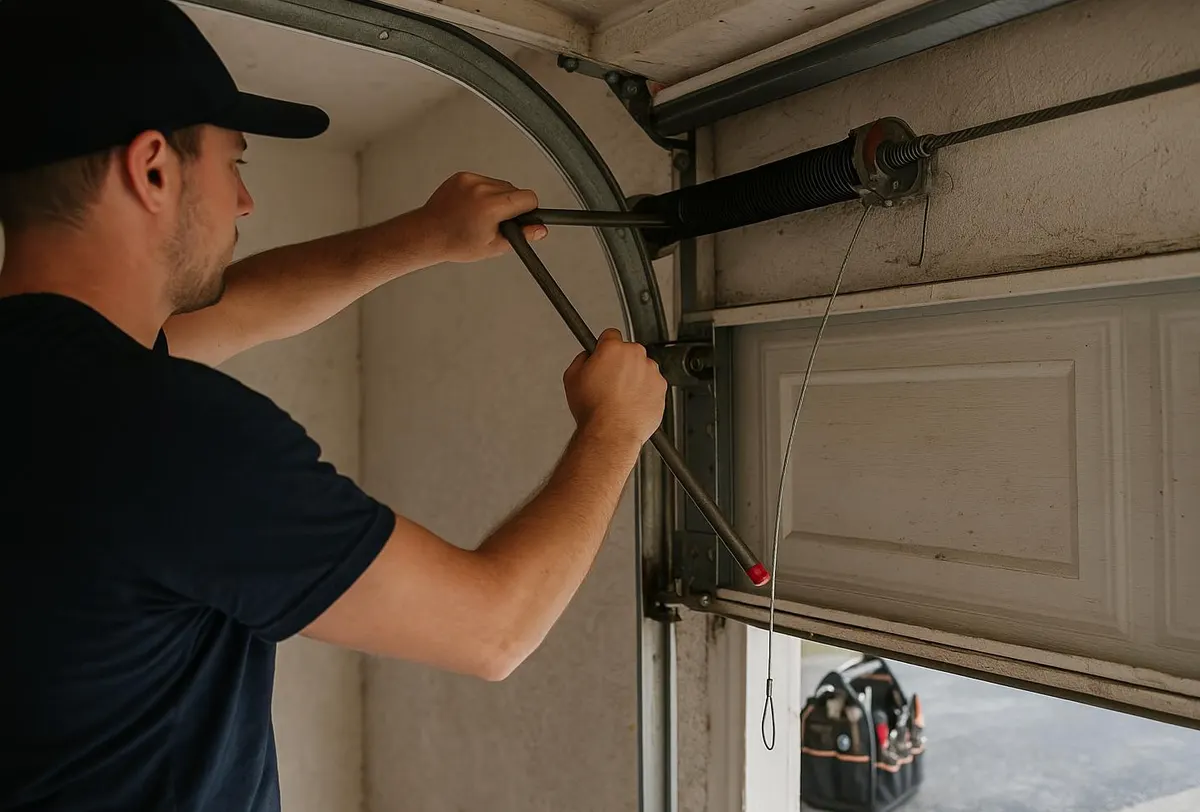
The exceptions: a door that's heavier than it used to be (swollen wood, added insulation, a wind-rated retrofit), a track that's slightly bent, or rollers that are worn — in those cases, the force dial is covering for a mechanical problem, not fixing one.
What Force Limits Actually Do
The force setting tells the opener how hard to push or pull before it decides something is blocking the door and should reverse or stop. It's a safety feature, not a strength upgrade. Too little force and the door reverses on its own weight or a light breeze through a cracked door. Too much force and the opener will push through real obstructions — a bike, a pet, a misaligned track — instead of stopping.
This is the setting people tend to crank up when the door "seems to be struggling." That instinct is the problem. If the door needs more force to move, something changed: a spring lost tension, a roller seized, a track shifted. Raising the force just hides that change until the motor, the gears, or the door panel takes the strain instead of the springs, where it belongs.
What Travel Limits Actually Do
Travel limits tell the opener exactly how far to run before stopping — one limit for fully open, one for fully closed. Set correctly, the door seats flush on the floor and stops cleanly at the top without slamming into the frame or stalling short.
Wrong limits show up as specific symptoms:
- Door reverses right before touching the floor — the close-limit is set too short
- Door keeps grinding or straining after it's already closed — the limit is set too far, so the opener keeps pulling after the door has nowhere to go
- Door doesn't open all the way, leaving a gap at the bottom — open-limit set too short
- Loud bang at the top of travel — open-limit set too far, slamming the door into the header
Why "Just Turn Up the Force" Is the Wrong Fix
This is usually the actual argument: one person wants to twist the force dial until the door stops reversing, the other says that's a workaround, not a repair. The second person is right. A door that needs excessive force to close is fighting something — unbalanced springs, a bent track, dry or rusted hinges, a panel that's swollen from humidity. Forcing the opener to overpower that resistance puts the load on the opener's gears and the door's top panel instead of the springs. Over months, that shows up as a cracked top panel, a stripped opener gear, or a torsion spring that fails suddenly instead of gradually.
The South Florida Factor
Humidity and salt air change this equation more than most people expect. Wood-composite and some steel-faced panels absorb moisture during the wet season and swell slightly, which adds resistance right where the door meets the frame — exactly where force and travel limits matter most. A door that closed fine in April can start reversing or straining in September simply because the panel is a hair thicker than it was. Hardware near the coast also corrodes faster, and a rusting roller or hinge adds drag that shows up as "the door needs more force" when it actually needs lubrication or replacement parts. If your home has a wind-rated door — common here given storm codes — remember those doors are built heavier to begin with, so factory force settings sometimes need a technician's adjustment after installation rather than a homeowner guess.
When to Call Precision Garage Door of Pompano Beach
If you've adjusted the force or limit dials on the opener and the door still reverses, slams, or struggles, stop adjusting and call. Our technicians check the actual cause — spring tension, track alignment, roller condition — before touching the opener settings, because resetting force and travel limits without fixing the underlying issue just resets the clock on the same problem. We handle this as part of standard Garage Door Opener Installation work and Garage Door Maintenance & Tune-Up visits, where we balance the door mechanically first, then set the opener to match — not the other way around.
If your opener settings have become a recurring argument at your house, let us settle it. Call Precision Garage Door of Pompano Beach and we'll get the door balanced and the opener dialed in correctly, the first time.